

Quad Foreign Ministers Reaffirm Strong Indo-Pacific Vision And Launch New Initiatives In Washington D.C.
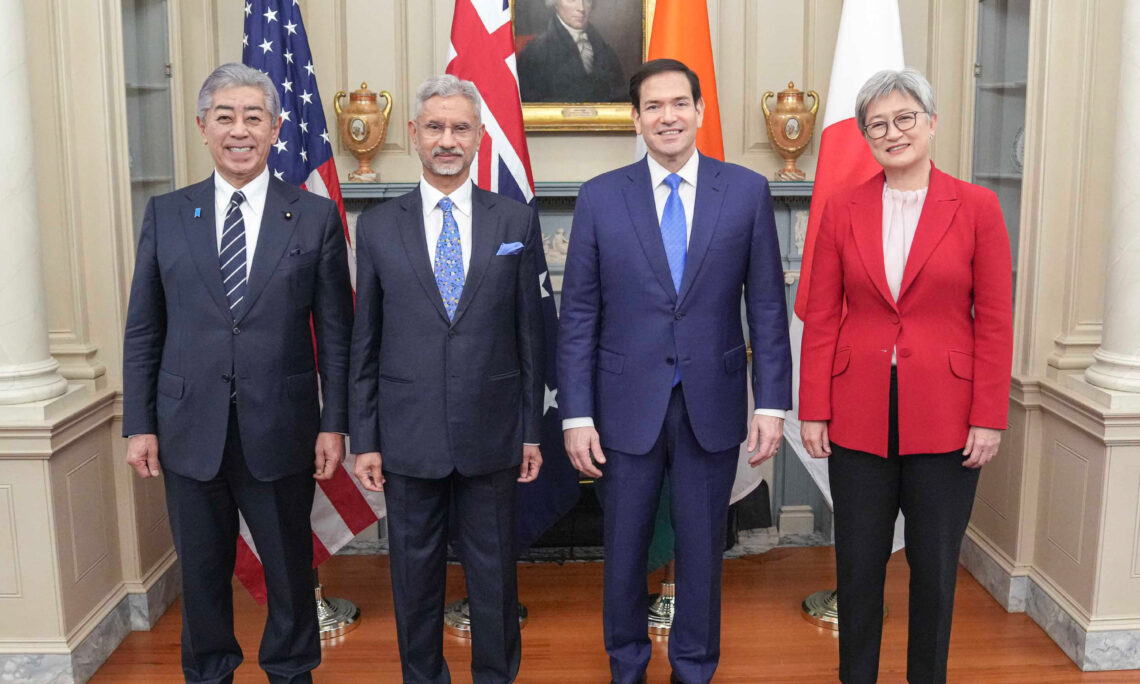
In a strong display of unity and collective determination, the Quad countries’ Foreign Ministers—Australia, India, Japan, and the United States—convened in Washington D.C. to reaffirm their commitment to an Indo-Pacific free, open, and inclusive region. In a statement released following the meeting, the ministers emphasized the Quad’s firm commitment to international law, sovereignty, and territorial integrity and against any attempt by any country to alter the status quo by force or coercion unilaterally. “As leading maritime democracies, we recognize that peace and stability at sea are vital for regional security and prosperity,” the statement read. The meeting addressed pressing regional challenges and opportunities, with a renewed focus on enhancing Quad cooperation to foster peace, economic growth, and security alongside partners across the region. A forward-looking Quad agenda was unveiled, anchored on four strategic pillars: Maritime and Transnational Security, Economic Prosperity and Security, Critical and Emerging Technologies, and Humanitarian Assistance and Emergency Response. This expanded collaboration aims to more effectively tackle the Indo-Pacific’s most urgent issues, while reinforcing ASEAN centrality, the Pacific Islands Forum, and the Indian Ocean Rim Association (IORA) as vital regional institutions.
On regional security, they voiced grave concern over tensions in the East and South China Seas. “We remain gravely concerned about developments in the East and South China Seas. We reiterate strong opposition to actions that seek to unilaterally alter the maritime status quo, including obstruction of navigational rights, interference with resource exploration, and militarization of disputed features. We emphasize the importance of upholding freedom of navigation and overflight in accordance with international law, particularly the United Nations Convention on the Law of the Sea (UNCLOS). We reaffirm that maritime disputes must be resolved peacefully and recall the significance of the July 12, 2016 arbitral ruling in promoting lawful dispute resolution.”
Economic resilience also featured prominently in the talks. The ministers highlighted the risks posed by non-market practices in critical mineral supply chains, emphasizing the need for diversified, transparent, and resilient systems to protect industrial stability and guard against coercive dependencies. Turning to regional flashpoints, the Quad denounced North Korea’s continued ballistic missile launches and illicit weapons programs that defy UN Security Council Resolutions. The ministers renewed calls for the complete denuclearization of the Korean Peninsula and condemned Pyongyang’s malicious cyber activities that help fund its prohibited weapons development.
The deteriorating situation in Myanmar was another key concern. The Quad urged the military regime to honor its ceasefire commitments and called for the full implementation of ASEAN’s Five Point Consensus to pave the way for an inclusive and sustainable resolution. The group pledged continued support for humanitarian assistance and regional stability. Reaffirming their united front against terrorism, the Quad strongly condemned a recent attack in Jammu & Kashmir. “We strongly condemn all forms of terrorism, including cross-border terrorism, and renew our commitment to strengthening counterterrorism cooperation. We condemn the terrorist attack in Pahalgam, Jammu & Kashmir, on April 22, 2025, which claimed the lives of 25 Indian nationals and one Nepali citizen. We express our heartfelt condolences to the victims’ families and call for the perpetrators to be brought to justice without delay, urging full international cooperation in line with international law and UNSCRs.”
In an effort to turn their strategic vision into concrete action, the Quad launched a series of new initiatives: The Quad Critical Minerals Initiative to create secure and diversified supply chains; enhanced maritime cooperation through training, legal discussions, and coast guard partnership; the inaugural Quad Indo-Pacific Logistics Network Field Training Exercise to enhance disaster response capacities; the inauguration of the Quad Ports of the Future Partnership in Mumbai to shape intelligent and sustainable port infrastructure; and humanitarian support amounting to more than USD 30 million for communities affected by earthquakes in central Myanmar. The ministers further raised concern regarding increasing disinformation campaigns and interference on Quad initiatives in the region, reaffirming their support for transparent and inclusive regional development.
Looking ahead, the Quad will continue to build on their shared democratic values and deepen strategic cooperation to ensure a resilient, secure, and prosperous Indo-Pacific. India will host the next Quad Leaders’ Summit later this year, with the next Foreign Ministers’ Meeting to be held in Australia in 2026
#QuadForeignMinisters#RegionalStability#QuadNations#printpublication
#modernembassyworld