


[ad_1]
LIVERPOOL, U.K. – Oct. 11, 2023: Britain’s main opposition Labour Party leader Keir Starmer applauds a speaker the final day of the annual Labour Party conference in Liverpool, northwest England, on October 11, 2023.
Paul Ellis | Afp | Getty Images
LONDON — The U.K.’s main opposition Labour Party last week set out the economic platform it hopes will propel it to power at next year’s general election, and the transatlantic parallels were clear.
Labour leader Keir Starmer promised to go “speed ahead” with investment in the clean energy transition that he said would create half a million jobs and power economic growth while delivering on the country’s climate goals.
“Clean British energy is cheaper than foreign fossil fuels. That means cheaper bills for every family in the country, but also a chance to make us more competitive across the board,” Starmer told the party conference in Liverpool on Tuesday last week.
“Countries like America are using this gift to create manufacturing jobs the like of which we haven’t seen for decades, and they’re not the only ones.”
Elsewhere, Shadow Chancellor Rachel Reeves set out an economic plan she dubbed “securonomics,” rooted in the belief that growth is created “from the bottom up and the middle out” — a word-for-word echoing of U.S. President Joe Biden’s economic philosophy.
Reeves promised last week to “rebuild Britain” as the party seeks to de-risk business investment in emerging technologies with a new national wealth fund, maintaining an active state while harnessing private investment to drive economic growth.
She also vowed to overhaul the country’s planning system in order to speed up infrastructure projects, a plan she claimed will unlock a further £50 billion ($61 billion) of private investment.
Reeves said that Labour wants to secure £3 from the private sector for every £1 of public money spent in the proposed national wealth fund, and the plan was widely acknowledged to have been inspired by U.S. President Joe Biden’s Inflation Reduction Act, or IRA.
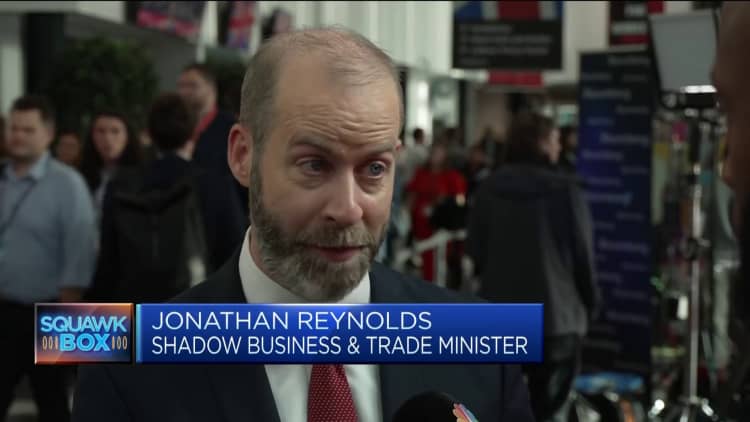
Reeves told the conference that business investment was the “lifeblood of a growing economy.”
“It is investment that allows businesses to expand, create jobs, and compete with international rivals, with new plants, factories and research labs coming to Britain — not Germany, France or America,” she said.
“But today, we lag well behind our peers for private sector investment as a share of GDP, with tens of billions of pounds less spent on new machinery and infrastructure.”
The Biden administration’s landmark IRA legislation — targeting manufacturing, infrastructure and climate change — generated more than $500 billion in investment during its first year, according to the U.S. Treasury, with $200 billion of that going into the clean energy sector.
Labour’s desired parallels to “Bidenomics” were discussed at a host of fringe events throughout the conference in Liverpool, particularly with regards to the “crowding in” of private investment — a Keynesian economic theory that suggests increased government spending can spur increased private investment.
‘It’s not Bidenomics’
But while the rhetoric and desired outcomes may sound uncannily similar, the key differentiator between “Bidenomics” and “securonomics” is in how the proposed investment in infrastructure to spur long-term growth is financed, according to Berenberg Senior Economist Kallum Pickering.
“Lacking in imagination, we have this bad habit of importing American politics and ideas. [Former Prime Minister] Liz Truss tried with Reaganism without the dollar and found out actually the dollar is what you need to just run massive deficits to cut taxes,” he told CNBC by phone last week.
Truss lasted just 49 days as prime minister last year after announcing a suite of unfunded tax cuts that roiled markets and the pound, sent mortgage bills skyrocketing and caused the Bank of England to intervene to prevent the collapse of multiple pension funds.
However, Truss has refused to yield to critics and at the Conservative Party conference earlier this month continued to push for current Prime Minister Rishi Sunak to enact sweeping tax cuts.
“Bidenomics is straightforward — it’s massive debt financed subsidies to stimulate the supply side of the economy,” Pickering explained.
“The key point is the debt finance subsidy. Just because the policies may be oriented towards boosting infrastructure and investment, unless they have that debt finance component, it’s not Bidenomics.”

The main reason this would not work in the U.K., he added, was that the U.S. has the “exorbitant privilege” of operating with the global reserve currency: the U.S. dollar.
“The U.S. federal government is going to be running a 6% deficit for the next few years in an economy with full employment — no other country can get away with this. And those deficits are subsidies for infrastructure, CHIPS Act, all this other menu of subsidies — this is not possible in the U.K.,” Pickering said.
The U.S. national debt passed a historic milestone of $33 trillion last month, with fiscal spending having ballooned by around 50% between the fiscal years of 2019 and 2021. The Inflation Reduction Act is expected to cost more than $1 trillion over the next decade, according to a University of Pennsylvania budget model.
Why the U.K. is different
Pickering noted that U.S. borrowing to generate a subsidy directly contributes to GDP, while potentially “crowding in” private investment and encouraging borrowing in other parts of the economy in order to “piggyback” on those subsidies.
“In the case of the U.K., because we wouldn’t be able to borrow in order to finance the subsidies, or at least not materially increase the deficit, it would have to come as a transfer, so you’d have to raise taxes somewhere, or to subsidize someone else,” he explained.
“And therefore net net — well, if you’re very good at fine tuning your economy with fiscal policy, and I have my doubts, maybe you get more growth out of that — but it’s not going to be anything like the scale or the effect of the Bidenomics, because we can’t borrow as much.”

This need for fiscal discipline was also a key tenet of shadow chancellor Reeves’ speech on Monday, as she called for “iron-clad fiscal rules,” directly addressing critics who suggest her approach is akin to traditionally conservative economic policy.
“Economic responsibility does not detract from advances for working people. It is the foundation upon which progress is built,” Reeves argued, having pledged that no tax rises will be announced before the general election.
Pickering suggested the strength of the U.K. economy and business had less to do with a potential change of party in power and more about the stability and eradication of tail risks associated with a “fragmented Conservative Party” that is still embroiled in internal disputes over issues ranging from Brexit to taxes.
He suggested that the security offered by stronger ties with the EU and Biden’s U.S. that would come with a Labour government would likely make the U.K. a more attractive destination for foreign investment, eventually allowing Labour to “loosen the purse strings.”
“So whereas the Conservatives are aiming to get the budget into balance within a couple of years, Labour would probably be able to run a couple of percentage points of GDP deficit, and that would not be immaterial,” he added.
[ad_2]
Source link