


[ad_1]
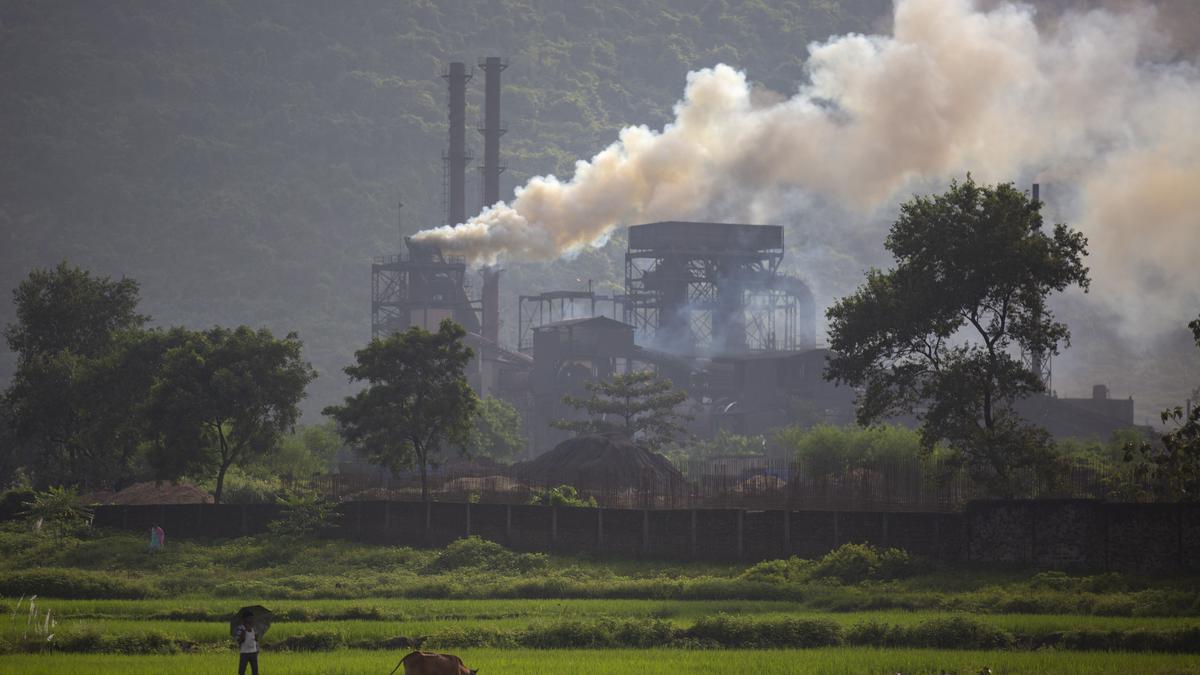
Smoke rises from a coal-powered steel plant in Hehal village near Ranchi, Jharkhand, September 26, 2021.
| Photo Credit: Altaf Qadri/AP
There is an almost linear relationship between global warming and cumulative carbon dioxide (CO2) emissions. The United Nations Framework Convention on Climate Change (UNFCCC) in 1992 noted that per capita emissions in developing countries are still “relatively low” and that their share in the global emissions will grow to meet their social and developmental needs.
The Convention recognises the ‘common but differentiated responsibilities and respective capabilities’ (CBDR-RC) principle. This means different States have different responsibilities and respective capabilities in tackling climate change. This principle has been reaffirmed in the Paris Agreement, whose main aim is to hold “the increase in the global average temperature to well below 2 degrees C above pre-industrial levels’‘ and pursue efforts “to limit the temperature increase to 1.5 degrees C above pre-industrial levels”.
According to the Intergovernmental Panel on Climate Change’s Sixth Assessment Report (IPCC AR6), every 1,000 billion tonnes of CO2 in emissions causes an estimated 0.45 degrees C rise in the global surface temperature. Axiomatically, limiting the rise in global temperature to a specific level means limiting cumulative carbon dioxide emission to within a carbon budget.
What is the global carbon budget?
The term ‘global carbon budget’ refers to the maximum cumulative global anthropogenic CO2 emissions – from the pre-industrial era to when such emissions reach net- zero, resulting in limiting global warming to a given level with a given probability. The remaining carbon budget indicates how much CO2 could still be emitted, from a specified time after the pre-industrial period, while keeping temperature rise to the specified limit.
The IPCC AR6 has shown that the world warmed by a staggering 1.07 degrees C until 2019 from pre-industrial levels, so almost four-fifths of the global carbon budget stands depleted. Only a fifth remains to meet the target set in the Paris Agreement.
For a 50% chance of limiting warming to 1.5 degrees C, the U.S. would have to reach net-zero in 2025, rather than 2050; Germany by 2030 instead of 2045; and the EU-28 bloc by 2031 instead of 2050.
Who’s responsible for cumulative global emissions?
According to the IPCC AR6, the developed countries have appropriated a disproportionately larger share of the global carbon budget to date. The contribution of South Asia – which includes India – to historical cumulative emissions is only around 4% despite having almost 24% of the entire world population. The per capita CO2-FFI (fossil fuel and industry) emissions of South Asia was just 1.7 tonnes CO2-equivalent per capita, far below North America (15.4 tonnes CO2-eq. per capita) and also significantly lower than the world average (6.6 tonnes CO2-eq. per capita).
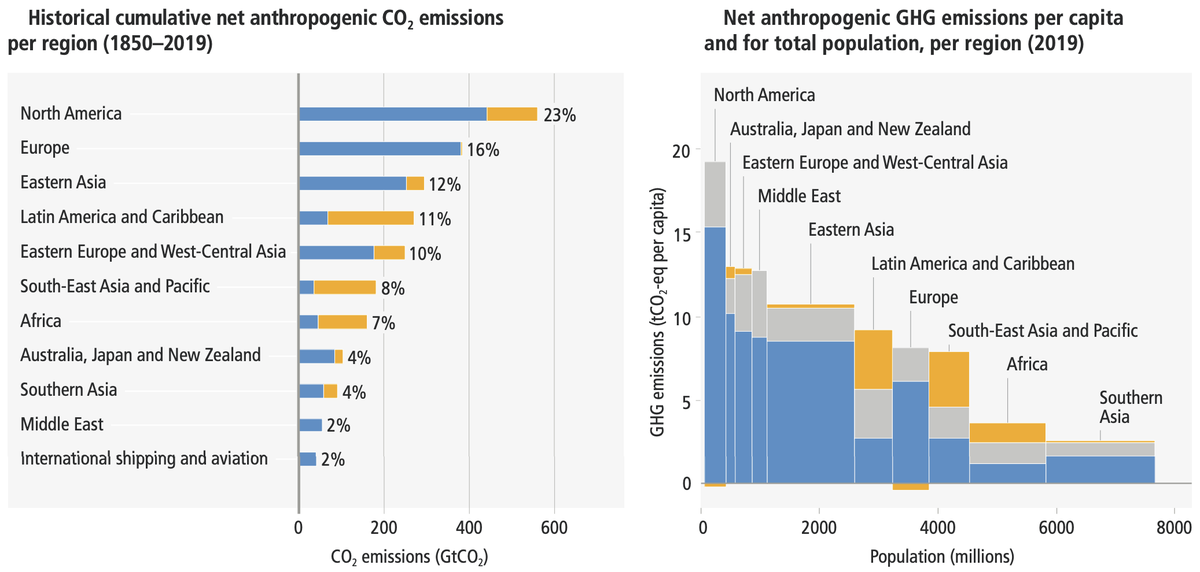
Legend: Dark blue shows “all GHG emissions”; light blue shows “CO2-FFI”; orange shows “net CO2 from land use, land-use change, forestry”; and grey shows “other GHG emissions”
| Photo Credit:
Climate Change 2022: Mitigation of Climate Change, Summary for Policymakers/IPCC
How does the carbon budget matter for India?
The global carbon budget for a given temperature limit is a global resource, common to the entire world, but is exhaustible and limited and with only equitable methods of sharing it, consistent with the foundational principles of the UNFCCC. India must recognise ‘fair share of the carbon budget’ as a strategic national resource whose reserves are depleting rapidly due to over-exploitation by developed countries.
In a rapidly depleting global carbon budget, if we fail to deploy resources at our command to forcefully use it as a strategic national resource, we will be shortchanged by new colonial techniques of developed countries. In almost all the emissions scenarios estimated by the IPCC, the world breaches an increase of 1.5 degrees C from pre-industrial levels in the early 2030s.
In 2022, oil, coal and gas accounted for 30%, 27% and 23% of the world’s total energy, while solar and wind energy together contributed only 2.4%. The world is still largely powered by non-renewable energy. Developed countries have tried to browbeat developing countries into accepting rapid, economy-wide changes. At the COP 26 talks in Glasgow, they forced the issue of phasing down the use of coal but then backtracked by reopening coal plants across Europe after the Russia-Ukraine war created an energy crisis.
This has illustrated that immediate phaseout of fossil fuels is infeasible in the face of shocks and also limits developing countries’ access to their ‘room to grow’. The developed countries have stretched the argument further by calling gas “green” and a “bridge fuel” towards their own decarbonisation efforts.
What should India’s stance be at COP 28?
According to the NITI Aayog-U.N. Development Programme’s Multidimensional Poverty Index Report 2023 review, India has been able to lift more than 135 million poor out of poverty in less than five years (2015-2021). India has also just extended food security welfare measures to more than 800 million people in the country, under the PM Garib Kalyan Ann Yojna, highlighting the magnitude of the challenge of poverty eradication after COVID-19.
Development is the first defence against climate change. How long will developing countries have to divert their scarce resources, manpower, and attention to meeting global problems created by developed countries? Until developed countries themselves undertake mitigation efforts in their own backyard, the exercise will be a hogwash. It is imperative that developing countries receive a fair and equitable share of their carbon budget alongside stronger and more fruitful commitments from developed countries – including the promised but unmet climate-specific new and additional finance.
Prime Minister Narendra Modi’s government has led from the front to foster international consensus to tackle climate change. To this end, India has set up the International Solar Alliance, the Coalition for Disaster Resilient Infrastructure, and the Global Biofuel Alliance. Through the ‘Lifestyle for Environment’ (LiFE) mission, the Indian government also aims to spread awareness of good lifestyle practices and establish that sustainable lifestyles are the best way forward.
At COP28, India must demand a fair share of its carbon budget or equivalent reparations to bring about fairness within the global order.
Only development brings with it an assurance to tide over the roller coasters of climate change. Scientists estimate that at a conservative price of $50/tCO2-eq, developed countries’ carbon debt to the world is pegged at over $51 trillion. Based on India’s historical emissions (1850-2019), it has a carbon credit equivalent of 338 GtCO2-eq., equal to around $17 trillion at $50/tCO2-eq.Without finance and technology as promised in 1992 at the Rio Earth Summit, developing countries stare at an even more unfair world.
The cover decision of the Glasgow Climate Pact recorded an unprecedented “regret” on the failure of the developed countries to provide US $100 billion dollars a year, as promised at the COP 15 talks in Copenhagen in 2009. We need more finance and less rhetoric from developed countries. For far too long, developed countries have had a free pass, and it is time for a new India to take them on.
J.R. Bhatt is Adjunct Professor, School of Natural Sciences and Engineering, NIAS Bengaluru. He tweets at @jrbhatt60. The views expressed here are personal.
[ad_2]
Source link