


[ad_1]
Not a game of seven stones
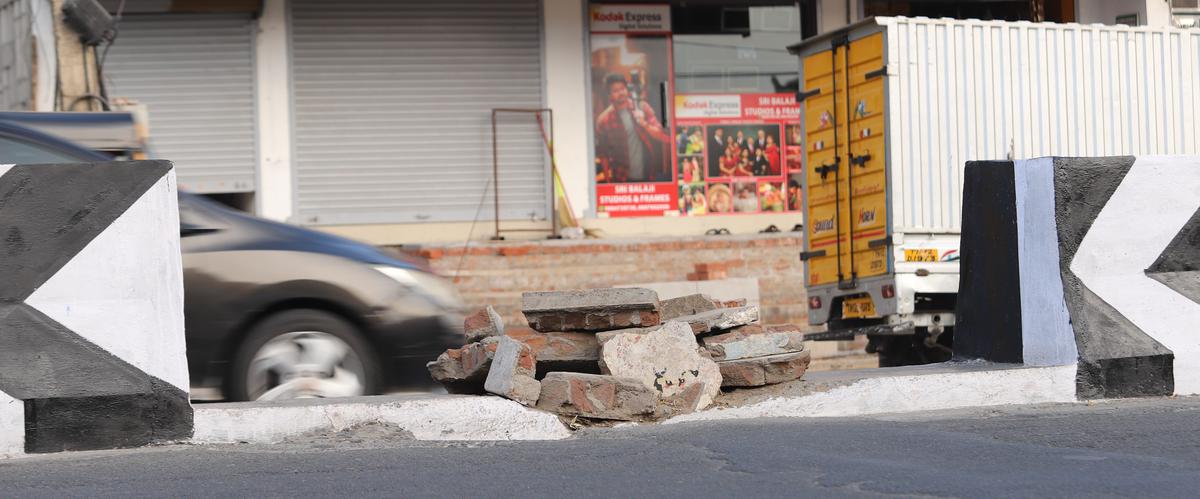
Every road has stakeholders of different stripes who have different needs. Some facilities are earmarked for certain stakeholders and the others are shared by everyone. Sometimes, a facility set aside for one can be misused by another stakeholder. To check the misuse, managers of the road cannot diminish the comfortable and legitimate use of the facility by the ones it was designed for. At least in a couple of places on East Coast Road — in Palavakkam (the picture ab ove) and Vettuvankani — a rather unconventional exercise to keep motorcyclists off a pedestrian refuge island is on display.
| Photo Credit:
PRINCE FREDERICK
At an island in Vettuvankanni, stones are stacked, and pedestrians tip-toe on to them, stand perched on them before proceeding to cross the road. The possibility of a stumble is built into this makeshift arrangement. In Palavakkam, on what is a relatively longer pedestrian refuge island, stones are heaped up in the middle to keep motorcyclists at bay. This desperate measure does not help the cause of pedestrians’ comfort, and to some extent their safety too. Raising the height of the landing in the island by basic masonry work would remove this unseemly mess.
A skipping rope

On East Coast Road, in the nebulous zone between Injambakkam and Akkarai, a “giant skipping rope” awaits pedestrians. A part of the power cable running over the median sags where a pedestrian refuge island arrives and proceeds to garland it. As this image from October 27 shows, the sag seems to have been carefully engineered to ensure the cable is not on the same level as the landing of the refuge island. However, this “skipping rope” of a cable retains the potential to be a tripping rope. A slight disturbance can likely twist this untethered string of the cable into a position that puts in uncomfortably underfoot.
A bend in the journey
In the median on Santhome High Road, a power cable riding “piggy back” on it assumes a peculiar posture when it reaches a pedestrian refuge island (opposite Leith Castle North Street), as this image from October 27 shows. Whenever a cable runs on the median like a traceur loping down parapet walls, it has to be “overpowered” and carefully tucked in when it hits pedestrian refuge islands. In this case, the cable has been coerced into assuming a rather unusual shape with the cable tubes neatly cut to get the angles right.

| Photo Credit:
PRINCE FREDERICK
The end result is certainly better than letting the cable hang sloppily, but it is still a case of a cable being in the way, uncomfortably underfoot. Having conduits for cables built into median blocks remains the best practice.
Clearly out of place

A median is primarily expected to ensure safety. A role involving aesthetics is appended to some medians. Medians playing just the primary role is never held up to standards of aesthetics. Only the mandate that the concrete (or metal) barricades stay in place, are not broken and do not leak pedestrians is applicable.
Medians that sport plants and any works of art are usually assessed, subconsciously, and sometimes consciously as part of an audit, for how well they look. Swami Sivananda Salai in Chepauk is a celebrated road, and Greater Chennai Corporation has revealed its plans for the road by stamping the Singara Chennai 2.0 mark into the boundary walls of the Cooum that trots alongside this road. In the light of this fanfare, the fact that this median garden supports (surely inadvertently) giant mikweed (calatropis gigantea) every few metres (as these images from October 26) is a surprise.
[ad_2]
Source link